Over the last several decades, we have learned a great deal about how people learn and develop from research in neuroscience; the developmental and learning sciences; and fields like anthropology, sociology, and social psychology. Recent syntheses of this research and its implications for educational practice, published in a series of articles in Applied Developmental Science,1 as well as recent syntheses of advances in the learning sciences,2 have pointed to important transformations in teaching practice needed to ensure that children experience the secure relationships, skillful teaching, robust curriculum practices, appropriate and relevant assessments, and personalized supports that will enable healthy development and successful lives inside and outside of schools and classrooms.
Among the understandings that have emerged are the following:
- The brain and development are malleable. The brain grows and changes throughout life in response to experiences and relationships. The nature of these experiences and relationships matters greatly for development. The brain develops most fully when children and youth feel emotionally and physically safe; when they feel connected, supported, engaged, and challenged; and when they have rich opportunities to learn, with materials and experiences that allow them to explore the world around them.
- Variability in human development is the norm, not the exception. The pace and profile of each child’s development are unique. Because each child’s experiences create a unique trajectory for growth, there are multiple pathways—and no one best pathway—to effective learning. The mythical “average” represents almost no one, and standardized pacing with a single way to learn misses most children’s needs.
- Human relationships catalyze healthy development and learning. Supportive, responsive relationships with caring adults are essential for children’s healthy development and learning. When adults have the awareness, empathy, and cultural competence to appreciate and understand children’s experiences, needs, and communication, they can promote the development of positive behaviors and confidence to support learning and buffer the negative effects of adversity.
- Learning is social, emotional, and cognitive. Positive relationships, including trust in the teacher, and positive emotions, such as interest and excitement, open the mind to learning. Negative emotions such as fear of failure, anxiety, and self-doubt reduce the capacity of the brain to process information and learn. Learning is shaped both by intrapersonal awareness, including the ability to manage stress and direct energy in productive ways, and by interpersonal skills, including the ability to interact positively with others, resolve conflicts, and work in teams. These skills can be taught and learned over time and across contexts.
- People actively construct knowledge based on their experiences, relationships, and social contexts. People dynamically shape their own learning. Children connect new information to what they already know in order to learn. This process works best when students engage in active, hands-on learning and when they can connect new knowledge to personally relevant topics and lived experiences, with opportunities to practice, receive feedback, and revise work toward growing competence. Knowledge acquisition is supported in contexts that recognize the diverse and varied strengths of learners and use nonpunitive assessments to help students and educators alike improve.
- Adversity affects learning—and the way schools respond matters. Each year in the United States, about 46% of all children are exposed to violence, crime, abuse, or psychological trauma, as well as homelessness and food insecurity. 3 These adverse childhood experiences can create toxic stress that affects attention, engagement, learning, and behavior. Poverty and racism, together and separately, make chronic stress and adversity more likely and can create generational trauma. Schools can buffer the effects of trauma by deepening educators’ understandings of adversity, creating environments that are personally attentive and culturally responsive, facilitating supportive adult–child relationships that extend over time, teaching social and emotional skills, and offering integrated student supports that remove obstacles to learning and offer healing-centered engagement. 4 Schools can also be designed to provide communitywide supports that mitigate adverse environmental conditions beyond the school walls that impact children.
The knowledge that we now have causes us to affirm many principles of developmentally appropriate practice that were uncovered more than a century ago while simultaneously requiring us to challenge assumptions that drove the design of 20th-century schools and still live at the core of contemporary instructional practice and school organization. This newer knowledge unseats old assumptions that intelligence is genetically determined and fixed at birth, that school opportunities are appropriately allocated based on tests that rank children in terms of their differential “potential,” that learning follows a uniform trajectory and is best accomplished by using a standardized curriculum that transmits ordered information, and that punishment effectively guides behavior.
In addition to new knowledge of how children develop, it is important to consider the kind of learning in which today’s young people need to engage—and hence the kind of learning that educator preparation programs also need to be able to support. In a context where knowledge is rapidly expanding and technologies and societies are rapidly changing, children need well-developed analytical thinking and problem-solving skills; the capacity to find, evaluate, synthesize, sort, transfer, and apply knowledge to novel situations; interpersonal skills that allow them to work with others and engage effectively in cross-cultural contexts; self-directional abilities that allow them to manage their own work and complex projects; abilities to find resources and use tools competently, including a wide range of technology tools; the capacities to build deeper knowledge and understanding about themselves and others and to communicate effectively in many ways across varied discourses; and the disposition and skills for lifelong individual and collaborative learning. Developing these kinds of skills requires a different kind of teaching and learning from prior eras when learning was conceptualized as the acquisition of facts and teaching was viewed as the transmission of information to be taken in and used “as is.”
The National Research Council’s review,5 for example, indicates that these higher-order thinking and performance skills are best developed through inquiry and investigation, application of knowledge to new situations and problems, production of ideas and solutions, and collaborative problem-solving. These tasks, in turn, require:
- strong self-regulation, executive functioning, and metacognitive skills;
- resourcefulness, perseverance, and resilience in the face of obstacles and uncertainty;
- the ability to learn independently; and
- curiosity, inventiveness, and creativity.
Students need opportunities to set goals and assess their own work and that of their peers so that they become increasingly self-aware, independent learners. To become productive citizens within and beyond the school, students also need positive mindsets about self, their developing identities, and school, along with social awareness and responsibility.6 The needed transformations—from assembly-line school designs; standardized, transmission-oriented teaching practices; norm-referenced testing; and exclusionary discipline to supportive communities that enable personalized attention to the fuller development of human potential—create a tall order for educators.
To accomplish these goals, educators need not only deep knowledge of how children develop and learn within social contexts and content areas but also skills and dispositions to transform that knowledge into humanizing and restorative practices in classrooms and schools. To be used effectively, this knowledge must be more than theoretical. It should be grounded in experience acquired in contexts for clinical practice that instantiate these principles. In many places, supporting this change means that preparation programs will need to take responsibility for finding, developing, and creating school environments that do not currently exist—as they do at Alverno College, as described in Preparing Students for 21st-Century Skills.
Preparing Students for 21st-Century Skills
- positive developmental relationships that support children’s attachment to caring adults and a supportive peer community, as well as their own growth and development;
- environments filled with safety and belonging, which are not only physically safe, offering consistent norms and routines, but also emotionally and “identity safe”7 so that all children know they are a valued part of the school community;
- rich learning experiences that support deep knowledge through authentic activities that build on prior knowledge and cultural contexts, enabling children to work collaboratively with peers to develop transferable knowledge and higher-order thinking skills;
- development of skills, habits, and mindsets that foster social, emotional, and cognitive capacities in support of personal and interpersonal awareness and skills, including cultural competence, as well as mindsets that support perseverance, resilience, and a community orientation that responds to the needs of others and contributes to their success; and
- integrated support systems that provide readily available academic, physical and health, and social service supports that remove obstacles to learning and support thriving.8
Building on the growing knowledge of development and learning, and of successful practices in educator preparation,9 we outline in this report a set of design principles for preparing educators to enact the science of learning and development (SoLD). In other words, these principles are rooted in both theory and practice, created through the application of research findings to educator preparation program design and the concurrent compilation of real-world illustrations of these findings from educator preparation programs that exemplify SoLD-aligned structures and practices. These principles include both the “what” of teacher preparation—the content educators need to learn about children and how to support their development and learning—and the “how”—the strategies for educator learning that can produce deep understanding; useful skills; and the capacity to reflect, learn, and continue to improve.
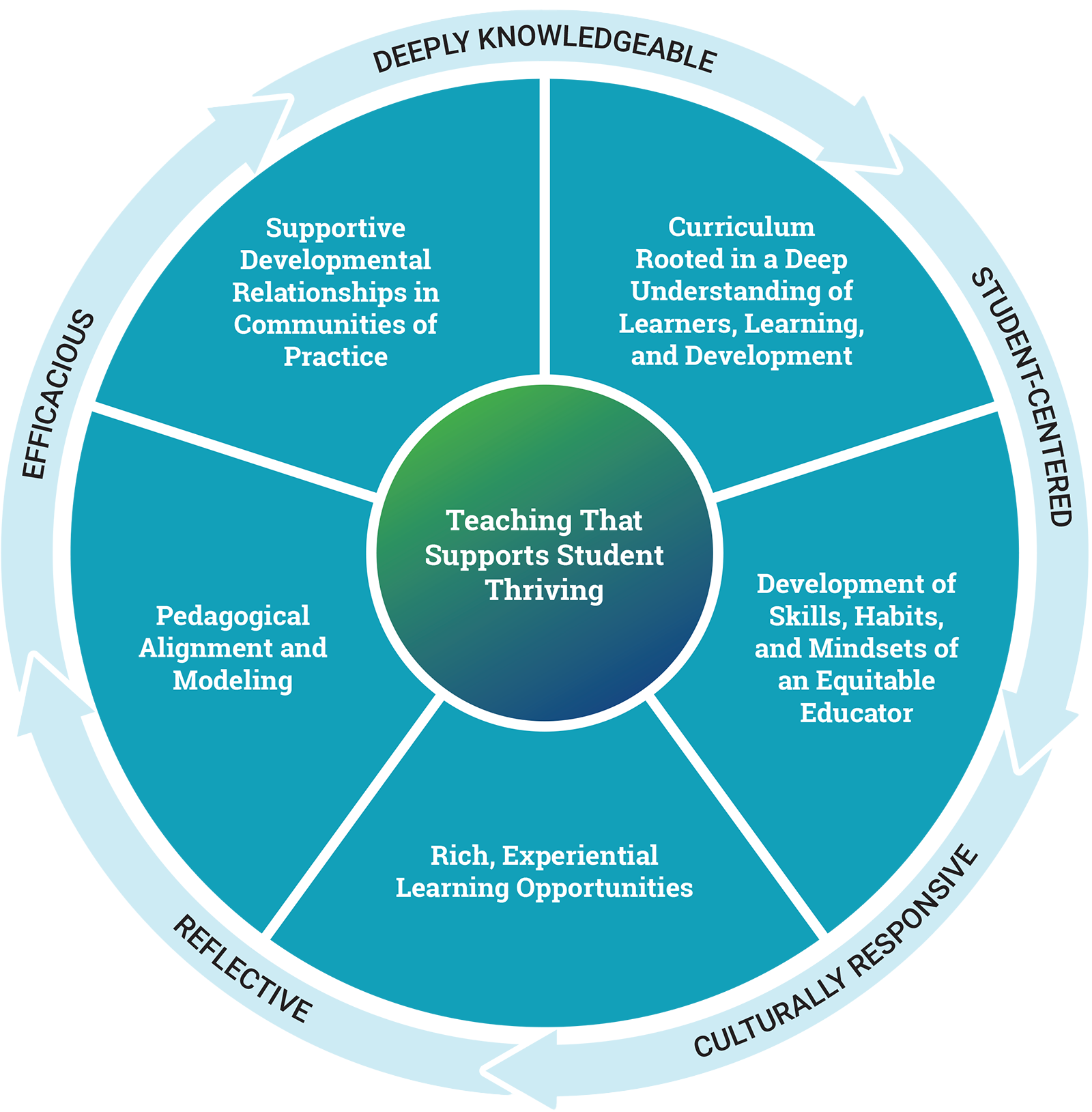
These design principles are:
- curriculum rooted in a deep understanding of learners, learning, and development;
- development of skills, habits, and mindsets of an equitable educator;
- rich, experiential learning opportunities;
- pedagogical alignment and modeling; and
- supportive developmental relationships in communities of practice.
- knowledge of learners and how they learn and develop within social contexts;
- an understanding of the subject matter and curriculum to be taught in light of the social purposes of education; and
- an understanding of teaching in light of the content and learners to be taught, as informed by assessment and supported by productive classroom environments.
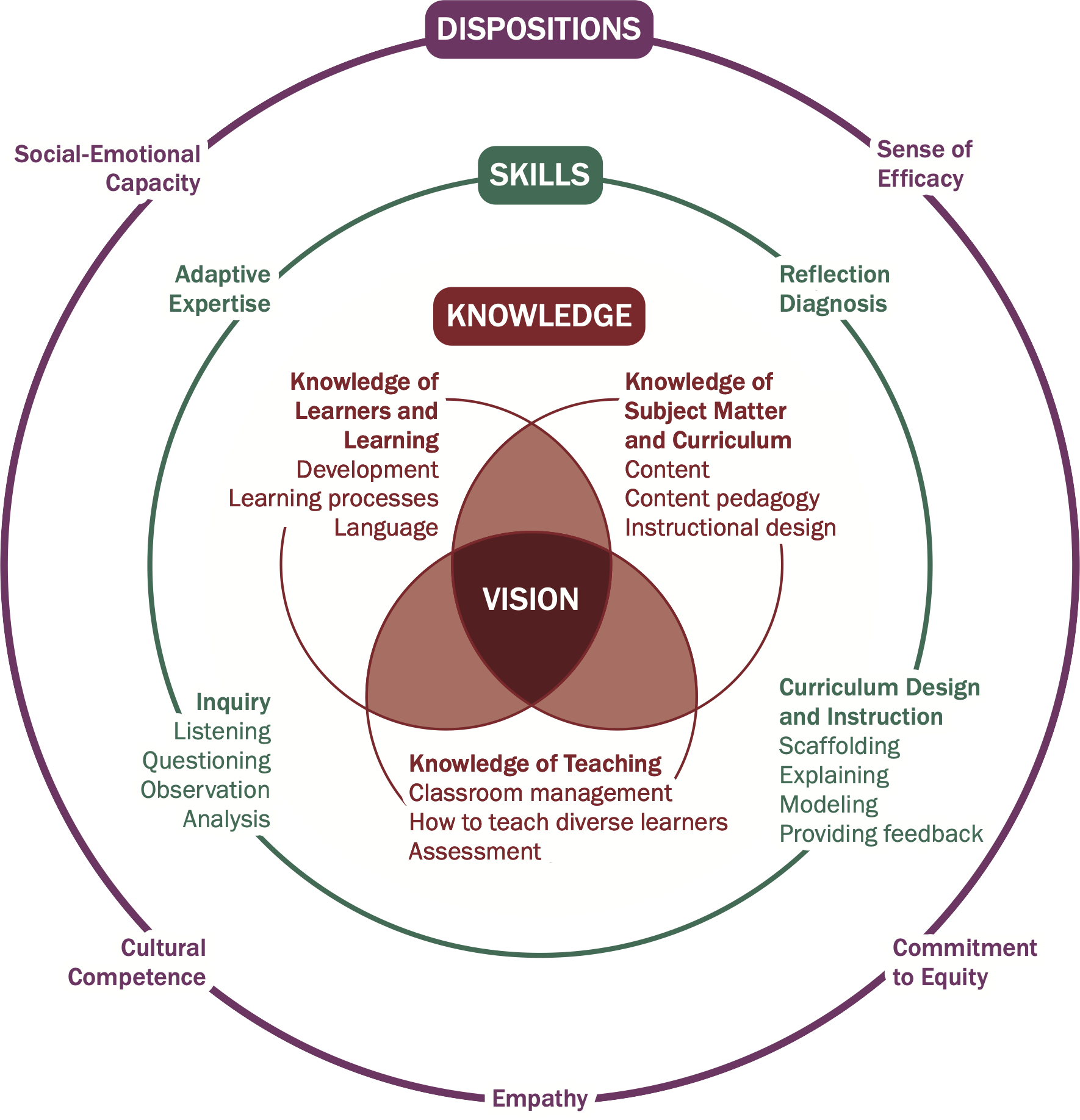
Research on effective preparation suggests that there are also strategies that can make a strong difference in the capacities of educators to build this set of knowledge, skills, and dispositions that support a vision of practice that centers the whole child.
As shown in Figure 3, these strategies include:
- anchoring candidate learning in the study of human development and learning;
- integrating theory and practice;
- providing opportunities for authentic practice, assessment, feedback, and reflection;
- engaging in inquiry and reflection; and
- collaborating in professional learning communities.
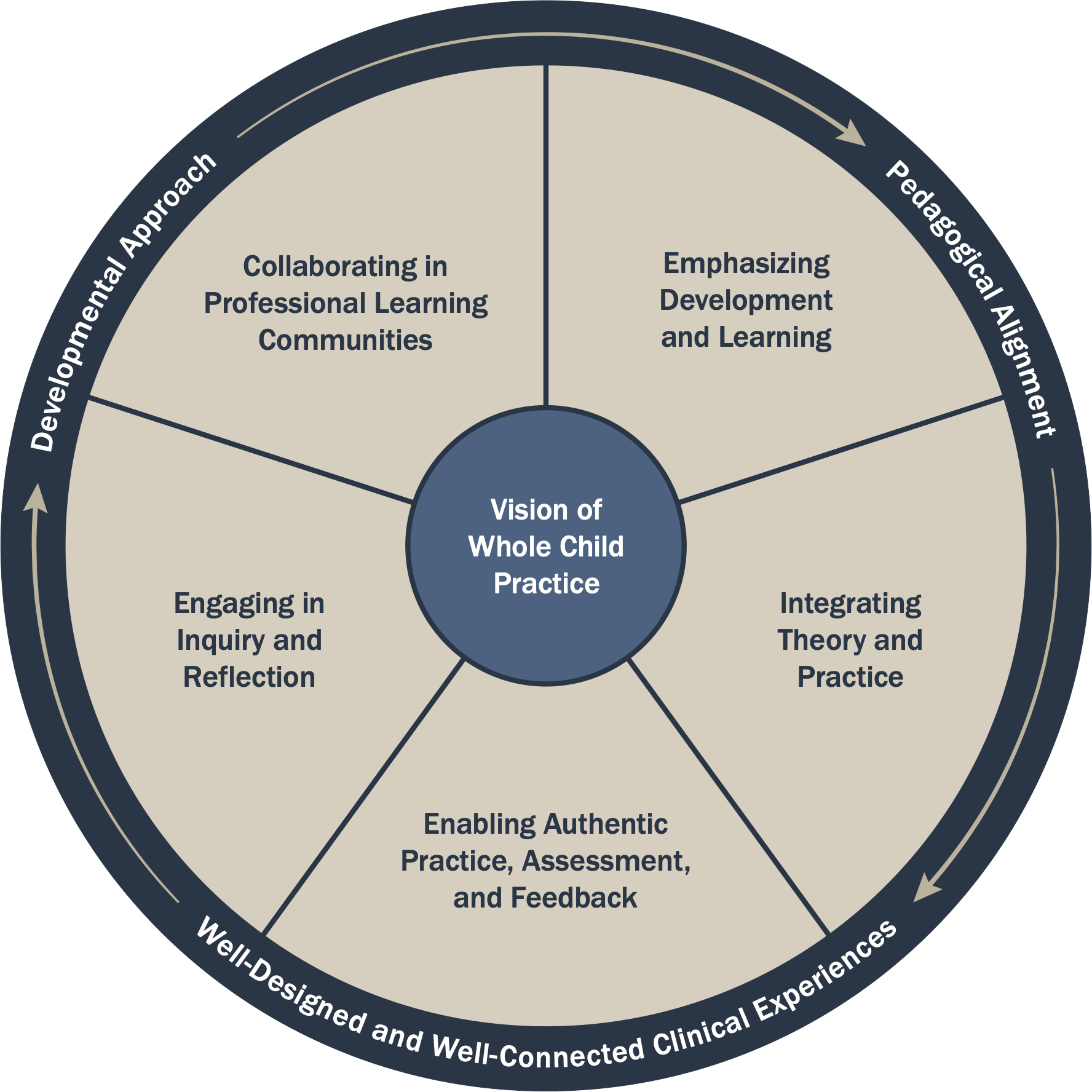
Powerful learning for educators can unfold when these practices are embedded in a developmental approach to learning to teach that is pedagogically aligned. This allows teachers to see and experience the practices they are learning to use and engage in metacognitive activities that allow them to reflect on the connection between what they have learned and how they see it being enacted. Such an approach supports prospective teachers not only with well-designed coursework but also with well-designed and well-connected clinical work that is joined through the reflective processes that faculty, cooperating teachers, and supervisors create in multiple settings.
Finally, it is important to acknowledge not only the content and practices of SoLD-aligned teacher preparation but also the support systems and resources that enable this kind of preparation. Research on the kinds of systems in place for programs that are succeeding in this kind of preparation identifies the importance of (1) well-established values that are infused in a program’s culture, structures, and practices; (2) leadership that prioritizes teacher preparation; (3) dedicated resources of both time and money that sustain collaborative relationships among program faculty and school partners that model and teach deeper learning practices; and (4) partnerships with K–12 systems and schools that create opportunities and spaces for shared and mutually beneficial work.10
Close attention to supports and resources is beyond the scope of this report, but they are critically important considerations in implementing the design principles described. While these design principles are not explicitly aligned with any particular type of educator preparation pathway, they do describe a comprehensive program that is clinically intensive and coherent. Such models are typically time- and resource-intensive, as is any effort at significant institutional change. Because we hope for wide and successful adoption of these design principles, we encourage our colleagues to approach the task with a full awareness of the challenge the principles represent to the status quo and the ongoing commitment they will demand from programs and educators.
1.
2.
3.
4.
5.
6.
7.
8.
9.
10.