
At 8 p.m. on a Wednesday night, Luisa Costa is in the middle of teaching her course, Language Acquisition and Learning in a Linguistically Diverse Society. Despite the late hour, the room is overflowing with energy from the 23 racially diverse teacher candidates. One candidate is participating over video chat, with her classmates moving the computer with her face on it to different corners of the room during the engaging class. This is an accommodation that Luisa gladly makes for students to help them balance their personal and professional commitments. She understands her students’ individual needs and adapts her practice to accommodate them, just as she encourages the teacher candidates to do for their students.
It is the second-to-last class of the semester, and Luisa is modeling a lesson that embodies effective instruction for all students, especially English learners. Luisa teaches the lesson in Spanish, even though many of her students speak only English. In this lesson, she wants to reinforce the pedagogies, dispositions, and mindsets the class has discussed throughout the semester. This is not the first time that Luisa has modeled a lesson for the teacher candidates using a language other than English. During the semester, she has given a model lesson in Farsi as well as Spanish. Luisa notes: “I put them in the shoes of the learner. We learn by doing.” And by having students sit through a lesson in a non-native language, she says, “the students have to strategize the way students in their classrooms would strategize.”
Luisa begins singing a catchy chant to the teacher candidates sitting in a circle, “ ¿Cuál es tu fruta favorita? Mi fruta favorita es la banana, la banana. ” During the chant, she points to the phrases written in Spanish on the board, then points to the different fruit written in Spanish next to a picture of the fruit.
Luisa goes through the chant a few times, then welcomes the entire class to join, with all the students following her visual signals as she points to the phrases and pictures of fruit. Next, Luisa asks for volunteers to respond to the question. Some of the fluent Spanish speakers respond with their favorite fruit. Luisa makes a tally mark next to the image of one teacher candidate’s favorite fruit on the board, la manzana (an apple).
The class begins to chant the question again, with another teacher candidate volunteering an answer. Next, Luisa explains, in Spanish, that the teacher candidates need to ask each of their classmates for their favorite fruit. To help, Luisa gives each student a paper that lists the Spanish word for different types of fruit next to a picture of the fruit. The sheet also includes the Spanish question and response for those who need the additional assistance. The teacher candidates jump up from the circle and begin excitedly moving around the room, practicing their Spanish by asking each other for their favorite fruit, responding, and tallying the responses. Because this is an abbreviated lesson, Luisa calls the teacher candidates back to the circle after a few minutes. She asks them to share, in Spanish, the number of teacher candidates who listed each type of fruit as their favorite. La banana was the most popular fruit. Luisa concludes the class by asking, “ ¿Cuál es le fruta favorita de la clase? ” The teacher candidates cheerfully respond, “ Le fruta favorita de la clase es la banana, la banana! ”
After the model lesson, Luisa asks the students to reflect on the lesson and their experience. One teacher candidate comments on the importance of “how you allow access to challenging content, regardless of the language diversity in the classroom, through the visible cues, charts, speaking slowly, repeating yourself or other comments that allow a child who might not have the language or skill to access the critical academic content.” Another teacher candidate remarks, “Consistency and routine are useful supports for students—in all stages of language development—to independently navigate tasks at their own pace.” Finally, another highlights the need to “meet students where they are and use what they do know to inform further learning and inquiry.”
As Luisa reflects on the lesson after class:
I model the lesson flow of how to start with the motivation, guided practice, independent practice—which doesn’t necessarily mean independent practice; it could be in small groups or partnerships. One of my goals is for them to be able to teach using effective strategies. [The lesson on fruit] is simple but makes a point about lesson flow, which is the slow release of responsibility from the teacher to the student.
What the Science Says
- Students come to the classroom with prior knowledge and experiences that must be addressed if teaching is to be effective.
- Students need to organize and use knowledge conceptually if they are to apply it beyond the classroom.
- Students learn more effectively if they take a metacognitive approach that allows them to consciously assess and manage their own learning.
Overview of Rich, Experiential Learning Opportunities
Programs should be designed to help teacher candidates deeply examine student learning for different students in different contexts and its relationship to instruction; to plan curriculum with students’ learning goals and trajectories in mind; to incorporate strategies that build on funds of knowledge and are supportive for individual learners; to build tasks that are motivating and well scaffolded; and to use a repertoire of teaching strategies that can build understanding by enabling discussion, application, practice, feedback, and opportunities to revise.
Programs should also model a vision of learning and development through which instructors, supervisors, and cooperating teachers enact and unpack approaches they expect teacher candidates to use, including practice, feedback, skill development, growth in understanding, and expansion of capacity for adaptive expertise. Pedagogical activities should promote inquiry, design and implementation, and cycles of reflection. They should also support intentional learning and problem-solving, developed through purposeful analysis of complex practice situations.
Through these experiences, programs can prepare educators to be lifelong learners who master a body of knowledge and who work with others to search for new answers when needed. Having a variety of candidate learning experiences is important for authentic engagement and can include case methods, action research, and practitioner inquiry tied to clinical experiences. As candidates grow in skill and understanding, this increases their motivation, efficacy, sense of purpose, and capacity for self-direction. Finally, rich learning experiences can be more deeply understood through authentic, performance-based assessments in which candidates connect theory and practice as they enact and analyze both individual instructional events and a full cycle of instruction, including student learning and its relationship to teaching.
What Teachers and Teacher Educators Can Do
Just as teachers must understand processes of learning and development, so too must those same processes shape the learning experiences of teacher candidates. Preparation programs should not only emphasize the knowledge, skills, and dispositions teacher candidates will need but also immerse them in rich, experiential learning opportunities within university classrooms and in authentic out-of-school contexts. Teaching is complex and demanding. Every day, teachers pursue a wide array of activities and goals, integrating knowledge of students, subject matter, and pedagogy while making frequent judgments on the fly. To prepare for this job, teacher candidates must learn to enact theory that is embedded in and inseparable from practice, using a range of techniques across a variety of circumstances to do so.2 Additionally, they must act deliberately to transcend the constrained views of teaching they developed through their “apprenticeship of observation” as K–12 students themselves.3
Rich, experiential learning is vital for the development of the identity and expertise of effective teachers.
Rich, experiential learning is vital for the development of the identity and expertise of effective teachers. The quality of these experiences is vital. Preservice programs should aim to create opportunities for joyful, compelling, and authentic learning. Such experiences enable candidates to create the same for their students later. They are also essential for the development of candidates’ adaptive expertise that enables teachers to make in-the-moment judgments based on curriculum goals as well as knowledge of learners and their paths to learning.4 Adaptive expertise prepares teachers to think pedagogically, plan based on students’ prior experiences and needs, reason through dilemmas, and analyze student learning to develop appropriate curricula for diverse learners. Being an adaptive expert means more than mastering a body of knowledge; it means being a lifelong learner able to work with others to search for new answers when needed. Preparing adaptive experts who can effectively apply their knowledge in a variety of circumstances requires programs to teach their candidates the “why” and “when,” not simply the “how to.”
Structuring Experiential Learning

Providing candidates with a variety of learning experiences is important for the development of complex understanding that can be applied to future, novel circumstances, including with and through technology and in the context of rehearsals involving teacher educators and novice teachers.5 Immersion in schools and communities that support the learning of effective and culturally competent practice contextualizes teaching and deepens understanding of the funds of knowledge available in families and communities. Many teacher candidates lack meaningful experiences in the racially, ethnically, culturally, and linguistically diverse communities in which they will teach, as do many teacher educators. Teacher educators and teacher candidates can learn to be culturally responsive and can expand their range of experiences by seeing students, families, and communities as a part of their learning communities, but this is just a beginning. Teacher educators must also model experience-based, culturally responsive, and sustaining teaching practices to support candidates’ learning through experiences they can then transfer to their own classrooms and students.
The example in Teaching Language Through Applied Experience illustrates this point more fully. In Bank Street College of Education’s “deeper learning laboratory,” teacher candidates are always learning themselves within immersive experiences. At the same time, they are also researchers in the laboratory, investigating and analyzing the elements and conditions that support the acquisition of deeper learning competencies. The vignette shows how teacher candidates are learning pedagogical strategies for English learners through such an immersive experience. Candidates uncover these pedagogical strategies by experiencing what it might be like to be learners in a classroom taught in a non-native language—and by experiencing the teaching strategies that enable them to learn.
For teacher candidates, experiential learning can mean taking on the student role. It also means practice in leading classrooms using the personalized, project-based pedagogies they have learned in their courses. Coordinated coursework and fieldwork are needed if programs are to provide such active learning opportunities for teacher candidates. Furthermore, programs must ensure that candidates have time and support to self-assess and reflect on the meaning and learnings from their experiences if these are to lead to flexible, transferrable understanding.
Designing Inquiry and Reflection
A full range of learning experiences—including practice, feedback, skill development, growth in understanding, and expansion of capacity for adaptive expertise—should be part of a scope and sequence for teacher preparation programs. Among the pedagogical activities embedded in this scope and sequence is teacher candidate inquiry, which adds richness to learning experiences through the deliberate development of flexible understanding. Cycles of reflection can be designed to help candidates consider teaching actions and their results in particular contexts. When deliberately constructed, such cycles—including opportunities for authentic practice, thoughtful feedback, and reflection—can accelerate learning. They create space to acknowledge successes and strengths while identifying areas for further learning. Such reflection can be structured in multiple ways, using analytical lenses offered by the science of learning and development (SoLD) or specific disciplines, or by focusing on enhancing clinical experiences through iterative practice and reflection cycles.
Teacher candidates engaging in self-reflection focused on providing rich experiences for their students can ask themselves, “How am I creating varied learning opportunities for growth based on my students’ diverse interests, learning approaches, developed abilities, and cultural backgrounds?” In seeking to answer this question, candidates can take note of:
- the ways they are communicating information (e.g., dialogue, group discussions, books, magazines, websites, emails, texts, phone calls, PowerPoint presentations, blogs, video);
- how often they provide choices for students in terms of the content students want to learn and how they learn it (e.g., in person, online, individually, small groups, pairs); and
- what different assessments are used to demonstrate what students understand, learn, and can do.
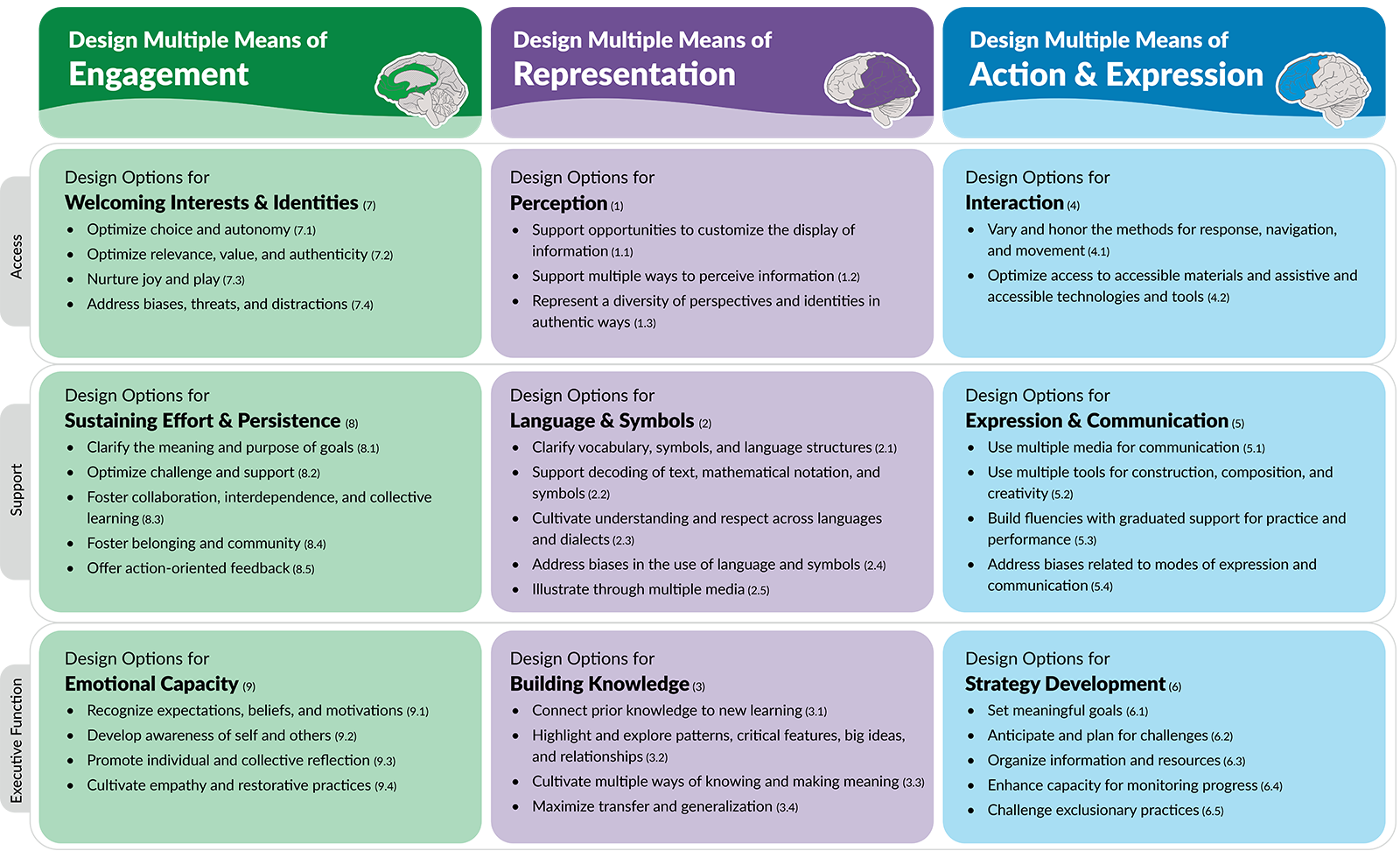
Universal Design for Learning Guidelines6 provide a structure for this kind of thinking about the strategies candidates use and the choices they provide. (See Figure 6.)
Case studies and action research are additional inquiry strategies that support purposeful analysis of teaching and learning and how to reason through complex practice situations. These strategies guide reflection and application, preparing candidates to learn about and from their students, plan for their students’ strengths and needs, and ask productive questions when they encounter novel teaching challenges. These strategies also model inquiry-based approaches candidates can employ with their own students. Case methods provide a useful link between theory and practice, allowing for the exploration of dilemmas, the development of reasoning skills, and the construction of more complex understandings of learning and development.7 Action research can support educators in developing an inquiry stance toward their work and a disposition toward reflective, analytic thinking along with the important skills of data collection, observation, analysis, and reflection.8
Teacher preparation programs use action research, as shown in Action Research in Action, as well as case methods to build complex understanding of many situations, including how children learn language, how their learning differs, and how schools and communities are organized (or not well organized) to support children and families and with what consequences. As shown in the vignette, action research projects allow teacher candidates to ask burning questions, collect evidence to answer the questions, discuss the process and their observations, respond to feedback, revise, and improve their research projects. More importantly, they are also learning to improve their teaching practice. Such focused practitioner inquiry can also support the enactment of culturally responsive learning through authentic engagement with families and communities across in-school and out-of-school settings.9
As candidates grow in skill and understanding, their motivation, efficacy, sense of purpose, and capacity for self-direction also increase.
These mindsets and attitudes should also be explicitly developed and supported. The knowledge, skills, and dispositions associated with teacher effectiveness are also associated with teachers’ sense of efficacy.10 Motivation and efficacy affect investment of effort, enthusiasm for teaching, and positive teacher–student relationships and are linked to improved motivation and achievement for PreK–12 students.11 Reflective educators can also identify the appropriate locus of control when challenges emerge, which contributes not only to motivation but also to an asset-based orientation toward families, communities, and students and a focus on their own role in creating conditions conducive to learning.
Supporting Performance Through Assessment
Finally, it is important to pair rich learning experiences with authentic and performance-based assessments. Authentic assessments allow candidates to bring together theory and practice to demonstrate their learning, providing rich formative data for teacher educators to use in modifying and adapting candidate learning opportunities and experiences.
These include regular informal and formal evaluations of student teaching, demonstrations of skills, and culminating assessments such as capstone portfolios. Among capstone-type assessments are teacher performance assessments based on the compilation of evidence of a cycle of instruction. Assessments should be used as a mechanism to provide teachers with information about their own practices as much as they are used to evaluate and monitor student learning and development. Teacher performance assessments may include lesson and unit plans, classroom videos, evidence of student learning, and commentaries describing how instructional decisions were made. Assessments that help develop adaptive expertise emphasize evidence and reflection, as they define teaching effectiveness as responsive to students’ distinctive backgrounds, experiences, and learning needs. Studies have found that these assessment processes are related to teacher effectiveness and stimulate teacher learning.12 They can also help develop adaptive expertise by focusing teachers’ attention on students’ thinking and development, the relationship between teaching decisions and student learning, and the dispositions needed to help all students develop their full potential.
1.
2.
3.
4.
5.
6.
7.
8.
9.
10.
11.
12.