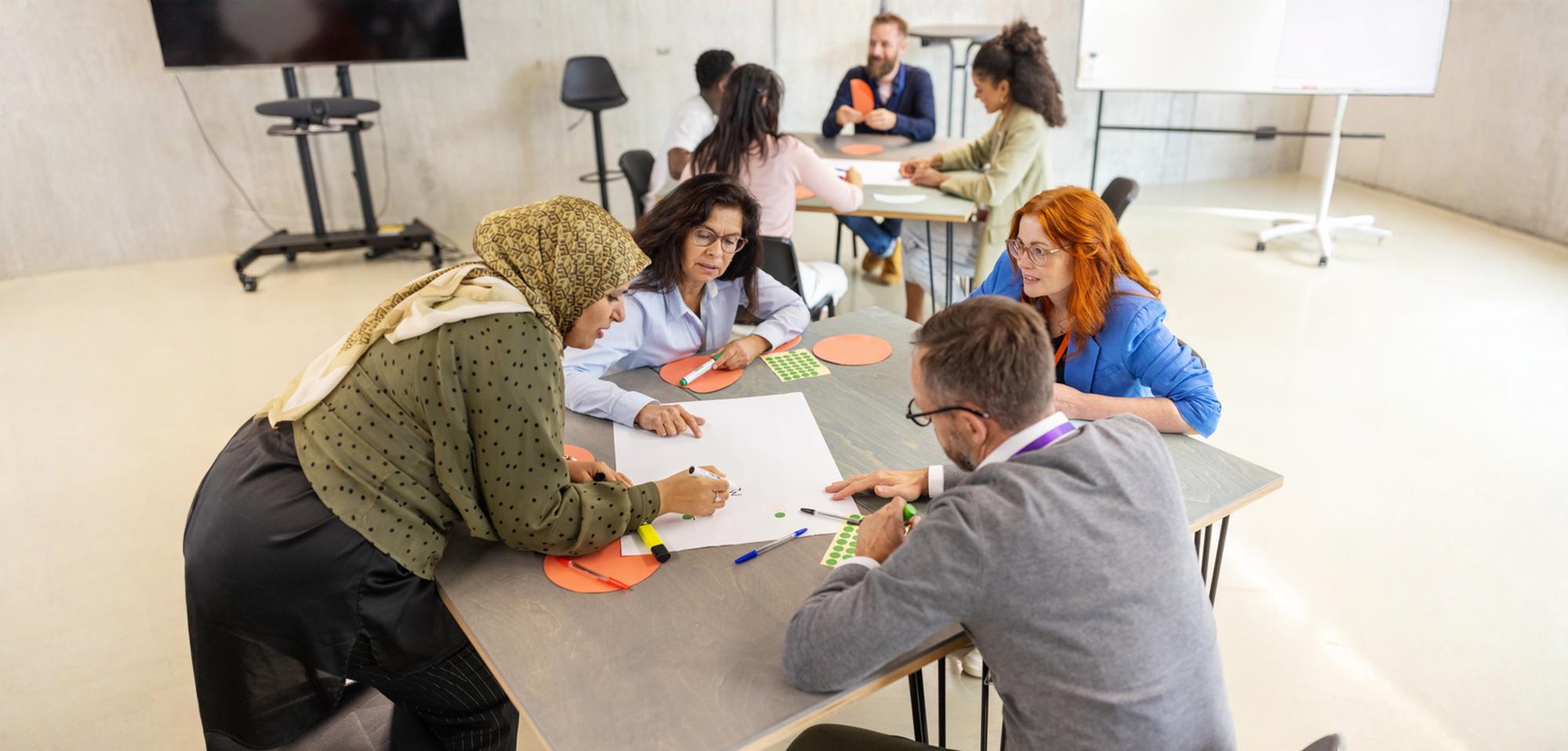
We have assumed for many years that, beyond the structured curriculum that is provided, the students internalize the pervasive qualities of the learning environment we try to create for them, that the qualitative characteristics of their own teaching styles will reflect, later, the qualities of their own personal experience in learning to become teachers.
The belief that teachers must have opportunities to learn in the same ways they will someday be expected to teach develops a strong and distinctive practice, immediately visible the moment one enters a classroom or a school touched by Bank Street preparation. In the Bank Street School for Children, children are building with blocks, making books, designing architecture and science projects, arguing math, and collaborating with one another on a kaleidoscope of projects. In college classrooms, prospective teachers can also be seen making picture books for children and curriculum books for teachers; experimenting with beans, sand, water, and other manipulatives for math and science; constructing museum and community trips for themselves and future students; and collaborating with one another on a variety of projects.
In Teaching Language Through Applied Experience, we saw how Luisa Costa taught teacher candidates how to support English learners by putting them in that role and modeling how to scaffold their learning. And in a vignette in the section Curriculum Rooted in a Deep Understanding of Learners, Learning, and Development, we met Jarod, a Bank Street student teacher who worked with Ted Pollen at Midtown West School in New York City.
While teaching with Pollen, Jarod was enrolled in Mathematics for Teachers in Diverse and Inclusive Educational Settings, where he was learning many of the practices he saw modeled in Pollen’s classroom. Jarod noted that this course provided him with “easy prompts that you can make yourself do as a student teacher … constantly asking [students] why: Why do you think that? Why did you do that? Can you show me how that works? Can someone else repeat what that person just said? Did anyone do something different?”
Jarod described how he saw Pollen, his cooperating teacher, model this type of inquiry in his classroom. Through both his Bank Street math course and his cooperating teacher modeling inquiry-based instruction in math, Jarod was learning how to develop questions that guide students to direct their own math learning, as well as how to draw on Vygotsky’s theory and support children’s learning within their own different zones of proximal development as they collectively teach and learn. As Jarod learned to scaffold students’ inquiry and thinking by asking questions, he was also learning how to interpret the answers he received from students in terms of their developing thoughts and understandings so he could figure out what they were ready to do next and what kinds of supports they might need.
What the Science Says
For new teachers, learning about pedagogy derived from the science of learning and development also means learning with and through such pedagogy.
The fundamental nature of learning and development does not change for adult learners. Experiences and relationships continue to be important; learning is still social, emotional, and cognitive; and learning continues to be a process of active construction of knowledge enabled by relevant, practical experiences supported by modeling and feedback. In addition, because all learners connect new information to prior knowledge through active knowledge construction, teachers have difficulty enacting pedagogical methods they have not had the opportunity to experience, and thus to know and understand in complex and meaningful ways. Therefore, for new teachers, learning about pedagogy derived from the science of learning and development also means learning with and through such pedagogy.
It is vital that educator preparation provides teachers with opportunities to develop a deep personal understanding of the strategies they can use and rich models of practice on which to draw to align their teaching with the science of learning and development (SoLD). Developing this understanding requires new teachers to see and experience the very kinds of teaching strategies they are expected to develop for their pupils.
In addition, effective experiences are those made educative through guided reflection and processing of the meaning of the experience. Neuroscientists have demonstrated that the development of neural pathways is associated with exposure to and generation of language.1 Like other students, teacher candidates sharpen their thinking as they converse about their reasoning and inquire into what they do not yet understand. When they can articulate concepts, use them in a task, see or hear other models of thinking, and get feedback, they learn more deeply. Similarly, learning is supported by techniques that lead to the elaboration of material, such as self-explanation, peer teaching, and representing information in multiple modalities. These techniques deepen conceptual understanding and strengthen mental models.
Overview on Pedagogical Alignment and Modeling

A critical program strategy for enabling teacher candidates to learn sophisticated approaches to teaching that extend beyond their previous school experience is pedagogical alignment in both coursework and clinical work around a coherent vision of whole child development, learning, and teaching. Educators’ capacity to build a positive, collaborative culture focused on whole child development and learning is shaped by immersion in supportive contexts that illustrate all the aspects of whole child pedagogy. It also means learning with and through such pedagogy, the goal and the guide for teacher educators.
In less formal terms, “pedagogical alignment” means that teacher educators must “practice what they preach,” with implications for programs and for teacher candidates. On the programmatic side, pedagogical alignment stands in contrast to long-established habits and institutional structures that position preparation as a site of knowledge acquisition and classrooms as sites of knowledge application. SoLD-aligned preparation challenges these distinctions and replaces these partial learning models with holistic ones. For candidates, their long experience in schools that afforded an “apprenticeship of observation”2 has generally produced conceptions about teaching that are partial and assumptions that are sometimes misaligned with the science of learning. These may need to be evaluated and reconsidered. This process, along with institutional structures and habits, makes pedagogical alignment and modeling a uniquely demanding principle for programs to implement. Among other things, it requires coherence around a vision of practice across the program—one that faculty both espouse and engage in—and continuous efforts to support program faculty and school mentors in practicing what they preach in concert.
Concentrated efforts are needed to create professional learning opportunities that can help educators develop the knowledge, skills, and dispositions to enact these insights. Integration of theory and practice around a SoLD-aligned vision, which is necessary for the development of adaptive expertise, is made possible by close partnerships between programs, schools, and districts. These efforts will be most successful if they engage educators in sustained, collegial efforts to experience and practice pedagogically aligned skills and strategies. This is particularly important in learning content-specific pedagogies that shape instruction in the disciplines—what it means to deeply understand concepts and engage in disciplinary practices in science, math, history, the social sciences, language and literature, or the arts.
In coursework and clinical work settings, instructors, supervisors, and cooperating teachers enact and unpack practices they expect candidates to use. They design tasks and processes for engaging them that are clear and support understanding, making their own thinking visible, guiding group processes and collaboration, and asking questions to solicit reflections. As they model good reasoning strategies, they support teacher candidates’ ability to take up these strategies themselves.3
What Teachers and Teacher Educators Can Do
A critical program strategy for enabling candidates to learn sophisticated approaches to teaching is pedagogical alignment around a coherent vision of whole child development, learning, and teaching. In both their coursework and clinical work settings, new teachers should experience the very kinds of teaching strategies they are expected to develop for their pupils.
Learning Pedagogy by Experiencing It
In subject areas, strategies may focus on the modes of inquiry in the disciplines—for example, approaches to scientific inquiry, historical or social science research, mathematical modeling, literary analysis or close reading, writing processes, and so on. In more cross-cutting areas like classroom management, they may focus on strategies like community circles, design of classroom responsibilities, and restorative practices that are used in both coursework and clinical site contexts so that candidates experience and see how they can create a strong learning community that functions to create membership, shared norms, and positive supports for behavior.

Engaging in these kinds of experiences or seeing them implemented in a context where analysis and reflection help unpack the teaching and learning process can give candidates a deep personal understanding of the strategies they can use, along with rich models of practice on which to draw. They also make it possible for candidates to engage with approaches to teaching and learning that extend beyond their previous school experiences.4
The first part of this strategy consists of building a positive, collaborative culture focused on whole child development and learning through policies and practices that create pedagogical alignment between adult and PreK–12 student learning. The knowledge, skills, and dispositions that educators need to do their jobs well are tightly aligned to the capacities they are being asked to develop in their students: the ability to think critically and solve problems; to apply knowledge to novel situations; to engage and communicate well with others; and to manage their work effectively. Similarly, just as children’s development and learning are shaped by interactions among the environmental factors, relationships, and learning opportunities they experience, so too is educators’ capacity to use the principles of the science of learning and development in practice shaped by immersion in supportive contexts. Therefore, it can be said that learning about whole child pedagogy for deeper learning and equity also means learning with and through such pedagogy.
In other words, pedagogical alignment means that enactment of the science of learning and development in practice is both the goal and the guide for teacher educators. This alignment requires that the structures and practices of educator preparation programs are shaped by a coherent vision of learning and development for both children and adults. Furthermore, the coherence of this vision must extend not only across preparation programs but also into PreK–12 settings and even out-of-school learning opportunities. Such coherence is enabled by well-supported clinical experiences tightly linked to coursework and integrating theory and practice. It is also a developmental approach, based on adult learning theory, aimed at scaffolding teacher candidates, and is among the stages leading to adaptive expertise. Such progress includes acquiring professional knowledge through guided experience, reflective practice, and structured inquiry. It is important to note that the development of adaptive expertise, like child and adolescent development, is both nonlinear and iterative, so teacher candidates’ learning will likely proceed in such a fashion.
Making the Implicit Explicit
In programs aligned to a coherent vision of learning and development as seen in Pedagogical Alignment in Action at Bank Street College, instructors, supervisors, and cooperating teachers enact and unpack practices they expect teacher candidates to use, including culturally responsive and empowering pedagogies, across courses and clinical settings. Enactment of practice is multifaceted and emphasizes engagement of candidates in the design, organization, implementation, and assessment of preparation program learning experiences. Teacher educators—instructors, mentors, and supervisors—in the university and at the school site model and name practices, explain why they are powerful, and indicate how they can be applied, making the implicit explicit so that candidates might gain understanding that they can transfer to their clinical experiences.5 This level of pedagogical alignment requires extensive engagement in clinical practice that instantiates what educators need to learn. Candidates must have opportunities to observe and put enacted pedagogies into practice, then reflect on the results if they are to acquire a deep, flexible, firsthand understanding of learning and development.6 These opportunities, combined with time and guidance for reflection, support teacher candidates’ metacognition and progress toward adaptive expertise.7
Learning by Giving and Receiving Feedback
In the example in the vignette, the session allowed candidates to practice with and experience feedback strategies that they will be able to use in their own classrooms. Their instructor had designed a task that instantiated the practices and included each candidate in experiencing them, rather than just describing them in the abstract. Through the use of videos, the candidates were also enabled to see and analyze other classroom practices used by their colleagues, expanding their experiential learning opportunities.
By definition, the integration of theory and practice around a SoLD-aligned vision, which is necessary for the development of adaptive expertise, can shape educator preparation programs and clinical partnerships. This alignment is dependent upon intentional opportunities to connect learning across courses and clinical settings. These opportunities allow candidates to develop and apply knowledge in practice through observation and analysis of teaching and structured planning and implementation of instructional strategies. These opportunities are made possible by close partnerships between preparation programs and PreK–12 schools and districts. Beyond aligned commitments to a shared vision of practice, partnerships of this type are built upon programmatic structures such as sufficient professional development and time for university-based faculty, site supervisors, district and school administrators, and mentor teachers to collaboratively engage in such practice. This collaborative engagement is addressed in greater detail in the section Supportive Developmental Relationships in Communities of Practice.8
1.
2.
3.
4.
5.
6.
7.
8.